Showing posts with label Cetus. Show all posts

Wednesday, February 15, 2012

Gravitational Lenses: the Mutant Truth of this Cosmic Conundrum

As defined by Dictionary.com's resources, gravitational lenses are most appropriately "a heavy, dense body, as a galaxy, that lies along our line of sight to a more distant object, as a quasar, and whose gravitational field refracts the light of that object, splitting it into multiple images as seen from the earth." Although this might seem confusing and rather arcane, this cosmic conundrum is mysterious and yet beautiful, all beginning with an Albert Einstein theorem: the theorem of relativity. Just barely scratching the surface on such a complex theory (which has been proven to be truth, see following paragraph), relativity scope deals that space and time are bent, causing things (i.e., distant objects) to be bent, or distorted. 

How was such a theorem actually confirmed to be true? Developed in 1915, it took three separate tests to confirm its reality; I will only contemplate one: the total solar eclipse. In the article published by Arthur Eddington (and other astronomers) entitled, A determination of the deflection of light by the Sun's gravitational field, from observations made at the total eclipse of 29 May 1919, Einstein's theory was claimed to be true, as Eddington writes describing the purpose, then the outcome of the endevour:
PURPOSE: "The purpose of the expeditions was to determine what effect, if any, is produced by a gravitational field on the path of a ray of light traversing it. Apart from possible surprises, there appeared to be three alternatives, which it was especially desired to discriminate between—  (1) The path is uninfluenced by gravitation. (2) The energy or mass of light is subject to gravitation in the same way as ordinary matter. If the law of gravitation is strictly the Newtonian law, this leads to an apparent displacement of a star close to the sun's limb amounting to 0” 87 outwards. (3) The course of a ray of light is in accordance with EINSTEIN’S generalized relativity theory. This leads to an apparent displacement of a star at the limb amounting to 1” 75 outwards."
RESULT: "Thus the results of the expeditions ... can leave little doubt that a deflection of light takes place in the neighborhood of the sun and that it is of the amount demanded by Einstein's generalized theory of relativity, as attributable to the sun’s gravitational field."

Now that we have determined that this is true and that time and space are actually bent, we can now look further into the mysteries of gravitational lenses. As stated before, a gravitational lens is the distortion of an object behind a closer object, which its light is seen differently than it would be seen. These are also referred to as Einstein rings. Before you try to comprehend this, look at the image below. The yellow object is a galaxy, the ring around it is as well, but not as you would expect it to have been.


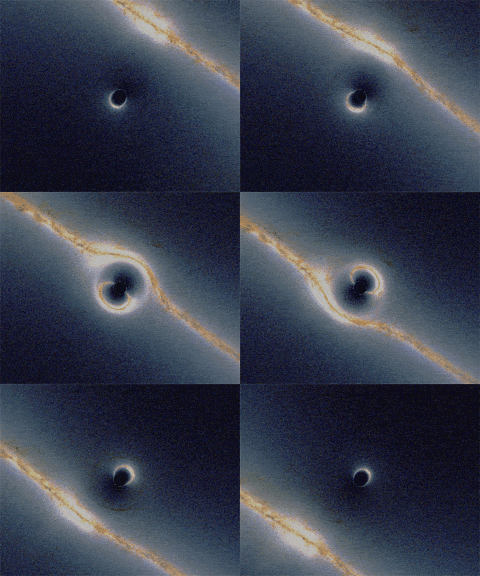
Gravitational lenses are at work in the above image! The object above is known as LRG 3-757, and APOD (Astronomy Picture of the Day, December 21, 2011) calls this a "mirage," which is indeed what it is. Watch this animation of a black hole lens, which distorts the galaxy behind it. Below is an image of the event, more like a series, which proves my point: 


You know that the galaxy behind the black hole in the images is straight, but when that black hole moves over it, we see a halo around it: that is the rings we see around galaxies, like LRG 3-757 above. These are not only beautiful in form, but intrinsic in its true scientific properties. These gravitational lenses are quite spectacular! You might think that only a few of these exist. This is not true, but rather astronomers have seen this effect in many different instances, of which each separate event being just as different as another. [Image index: 1)  Abel 1689 in Virgo. You can see the small, different mutation circlets in the background if you look hard enough. 2) Abel 370 in Cetus. These are more pronounced. 3) Abel 2280. These are thin and wispy, quite spectacular.   


Considered quite different than the above gravitational lenses, the Einstein's Cross in Pegasus (pictured below) is the most exotic of them all. Known by its appropriate name, Q2237+030 or QSO 2237+0305, is a gravitationally-lensed quasar behind ZW 2237+030, another object. Wikipedia states that "four images of the same distant quasar appear around a foreground galaxy due to strong gravitational lensing." 


Thursday, October 27, 2011

Occultation of Minor Planet 136199 Eris Gives Significant Data

Last November 6, 2010, minor planet 136199 Eris occulted the star USNOA2 0825-00375767 in the constellation Cetus. What significance does this relate to? Before this occultation, trans-Neptunian object Eris was assumed to be smaller than Pluto, its presumably larger contemporary. But now, Eris' diameter has been measured and not guesstimated, but rather an exact measurement. The video below shows the occultation, as astronomers would have seen it on that November day.


USNOA2 0825-00375767, with a magnitude of 17.25 is a very faint star, but nothing is too dim for the Belgian TRAPPIST telescope at ESO’s La Silla Observatory to see. This event has been described by ESO as a "very rare and difficult to observe" event becasue minor planets are very small - and an occultation is even rarer. But these things do occur, for Eris will occult again in 2013, ESO reports. Astronomers first observed the star using the MPG/ESO 2.2-metre telescope at ESO’s La Silla Observatory, and a another team carefully predicted the time and what would occur during the occultation. "Observing occultations by the tiny bodies beyond Neptune in the Solar System requires great precision and very careful planning. This is the best way to measure Eris’s size, short of actually going there," explains Bruno Sicardy, the lead author.

Twenty-six places global observed the occultation and were henceforth able to determine the diameter of Eris, which had not yet been accurately determined.  Eris is a dwarft planet, today known to be the most massive, of the Kuiper Belt - the region of the solar system which contains the "remains," as astronomers call it. Eris is a dwarf planet, as well as other well-known objects such as Pluto, Sedna, and Makemake. The planet itself is magnitude 18.7 and it orbits 97.56 AU, or 9,068,768,557.0108 miles from earth. It has one moon, Dysnomia, as shown in the picture below. This moon was used to help determine the mass of Eris - which is 27% heavier than Pluto, astronomers found.

Artist's conception of Eris (with Dysnomia above)

Previously estimated was the diameter of Eris at around 3000 km (or 25% larger than Pluto), but now, the research has proved that both minor planets are essentially the same size, as Eris' predicted diameter was 2326 km. (Pluto's diameter is approximately 2300 or 2400 km, as New Horizons will find out in 2016. Pluto's obstructive atmosphere makes occultation predictions hard to accurately define).

The below picture shows trajectories of the occultation, "the three oblique solid lines show the star trajectories relative to Eris, as seen from San Pedro, La Silla and CASLEO, with the arrow pointing towards the direction of motion," as multiple authors of A Pluto-like radius and a high albedo for the dwarf planet Eris from an occultation, a paper presenting their discoveries, write. The names below are observatories in Chile where this occultation was viewed.


“This density means that Eris is probably a large rocky body covered in a relatively thin mantle of ice,” comments Emmanuel Jehin, who contributed to the study. “It is extraordinary how much we can find out about a small and distant object such as Eris by watching it pass in front of a faint star, using relatively small telescopes. Five years after the creation of the new class of dwarf planets, we are finally really getting to know one of its founding members,” concludes Bruno Sicardy.

Friday, August 5, 2011

Protoplanet 4 Vesta Reaches Opposition August 5

Asteroid (and protoplanet) 4 Vesta reaches opposition August 5, and should be a great target for observers the next few weeks. Tonight, Vesta will shine around magnitude 5.63 (bright); to learn more about observing Vesta, come to our minor-planets viewing page, courtesy of Sky&Telescope, in the section entitled "Viewing 1 Ceres and 4 Vesta through the rest of 2011."
...The two brightest and most massive objects in the asteroid belt come alive in the night sky: just for you to view. Currently in 2011, Vesta (which is now being visited by Dawn) is in Capricornus, continuing it's 3.6 year orbit in the asteroid belt. Ceres, on the other hand, takes longer to orbit at 4.6 years and is about 1 and one half constellations to the east, on the Aquarius/Cetus borderline. 2012 brings these objects into Taurus, where Mars sits now (July 20).

To view these asteroids, Vesta will be up all night (especially around 3 am local time); but both objects will be in best view at opposition. Opposition is appropriately when an object is the highest in the night sky, as viewed from your position on earth. Vesta is in opposition August 6, and Ceres, September the 16th. Here is a good magnitude list to show you the magnitude of the object on a certain date...
Vesta will be viewed in the constellation Capricornus
This year, Vesta will be the brightest minor-planet (asteroid, protoplanet, etc - whichever you wish to call it) visible to us. "The best Ceres will manage this year is magnitude 7.6 and Pluto a meagre magnitude 14.3," write the Loughton Astronomical Society. Being at opposition is a fairly major astronomical event, but can opposition be defined? In the astronomical sense, opposition is "the position of an outer planet (or asteroid) when it is in line...with the earth as seen from the sun and is approximately at its nearest to the earth," Collins English Dictionary defines. Our chart shows this example.


Vesta will be best seen around midnight, but it reaches opposition at 10:25:57 UT, which was respectively 6:25:57 this morning (August 5). Vesta's magnitude is still going strong though!

Want a glimpse of Dawn? Learn more here...