WISE INFRARED EXPLORER REVEALS A NEW SET OF COOLER STARS: ACTUALLY THE COOLEST YET
Newly discovered by the WISE Infrared Explorer, astronomers have discovered a new class of stellar bodies that are apparently the coolest yet. According to NASA's Jet Propulsion Laboratory, these stars are found to be as cool as the human body - which is extremely cool for a star. Termed as "Y dwarfs," these stellar orbs are almost impossible to see or locate, due to the fact of their temperature. That's where WISE is then needed; WISE can see Infrared, therefore, can notice the luminosity of even cold stars like these.
"WISE scanned the entire sky for these and other objects, and was able to spot their feeble light with its highly sensitive infrared vision," said Jon Morse, Astrophysics Division director at NASA Headquarters in Washington. "They are 5,000 times brighter at the longer infrared wavelengths WISE observed from space than those observable from the ground."
After researching the topic intensively, WISE came to the conclusion that these Y class of stars are the coldest members of the brown dwarf family, also referred to as stars which have 'failed.' They are too low in mass and can't make enough heat to match up with other stars, therefore, they may seem like a dying star, but aren't mind you. These are a true class of stars that are stars, but just a little cooler than usual. Stars vary in degrees from being 50 thousand Kelvin, to 3600 degrees Kelvin, and now, to about 100 degrees Fahrenheit. These stars have died out quickly (their strong-burning cores) and are steadily burning at a temperature close to the human body. When viewing these, astronomers have appreciated their discrepancy from being close to bright parent stars - if they are, they can be almost impossible to view.
WISE found about 100 brown dwarfs in a search through the sky, six turned out to be Y-class. WISE 1828+2650, one of the six, holds the record for coldest brown-dwarf star yet. It's 80 degrees Fahrenheit, or 25 degrees Celsius! "The brown dwarfs we were turning up before this discovery were more like the temperature of your oven," said Davy Kirkpatrick, a WISE science team member at the Infrared Processing and Analysis Center at the California Institute of Technology in Pasadena, Calif. "With the discovery of Y dwarfs, we've moved out of the kitchen and into the cooler parts of the house."
So far, the new stars are closer than we have expected them to be. One star, WISE 1541-2250, is just nine light-years away and could become the seventh-closest star to the Sun. The rest of the group are scattered throughout the heavens, mainly at the distance of forty light-years. "Finding brown dwarfs near our sun is like discovering there's a hidden house on your block that you didn't know about," Cushing said. "It's thrilling to me to know we've got neighbors out there yet to be discovered. With WISE, we may even find a brown dwarf closer to us than our closest known star."
Who knows? Maybe a new star will be closer than expected - maybe closer than Proxima Centauri, just four light-years away.
COSMIC ACCIDENT: DISTANT BLACK HOLE CONSUMES STAR
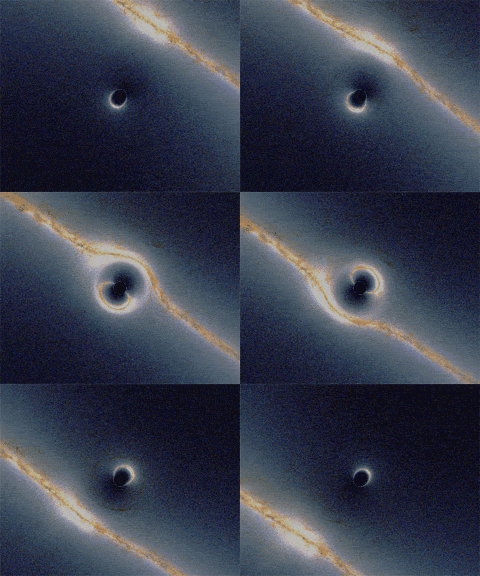
"Active galactic nuclei, which are powered by long-term accretion onto central super-massive black holes, produce relativistic jets with lifetimes of at least one million years, and the observation of the birth of such a jet is therefore unlikely," opens the abstract of Birth of a relativistic outflow in the unusual γ-ray transient Swift J164449.3+573451, discussing the details of the 'cosmic accident' which occurred in March this year (2011). Swift J164449.3+573451, also referred to as GRB (Gamma-Ray Burst) 110328A, is a troublesome, active GRB in the constellation Draco, 3.9 billion miles away from earth, and is described as a 'deeply plunging star,' from GRB 110328A/Swift J164449.3+573451: The Tidal Obliteration of a Deeply Plunging Star?
"Incredibly, this source is still producing X-rays and may remain bright enough for Swift to observe into next year," said David Burrows, professor of astronomy at Penn State University and lead scientist for the mission's X-Ray Telescope instrument. "It behaves unlike anything we've seen before."

According to the NASA/Goddard Space Flight Center, Swift J1644+57's dormant black hole had awaken and is now consuming the star, ripping it due to the fact of intense tides. Central black-holes are not uncommon in the vast varieties of galaxies in the universe, but action like this is rare. From recent studies, the black hole that is consuming GRB 110328A may be twice the mass of the Milky Way's black hole (4 million solar masses), and this explains why such behavior is occurring.The innermost gas in the center of the star is spiraling into the black hole, at scorching temperatures beyond our comprehension, in which swift movement and magnetism create oppositely directed 'funnels,' also called 'jets.'
Now, the jets expelled by the gamma-ray burst drive mater at velocities greater than ninety percent the speed of light, forming on the black hole's 'spin axis.' This is normal in some cases, but this case is different, one of these jets is pointed straight at earth. "The radio emission occurs when the outgoing jet slams into the interstellar environment," Zauderer explained. "By contrast, the X-rays arise much closer to the black hole, likely near the base of the jet."
Although this can't put any threat to earth, disturbed stars are interesting bodies that are mostly observed because of their luminosity. They are incredibly bright, but because of their distance are around magnitude 22. Source. Read more from the links above.
PULSAR INCREDIBLY METAMORPHOSES PLANET MADE OF DIAMONDS
PSR J1719-1438, a pulsar, 4000 light-years from earth in the constellation Serpens, is a unique creation that has changed itself into a new body. The research team at the ARC Centre of Excellence for All-sky Astrophysics (CAASTRO) has reported this unique and incredible finding in an issue of Science, where their research paper is published.
This pulsar is not like any other pulsar. But what is a pulsar? According to ScienceDaily.com, a pulsar is a "small spinning stars about 20 km in diameter - the size of a small city - that emit a beam of radio waves. As the star spins and the radio beam sweeps repeatedly over Earth, radio telescopes detect a regular pattern of radio pulses." This pulsar has a companion as the picture below describes.

Meanwhile, astronomers have noticed something peculiar about the patterns of spinning and modulation of the pulsar. PSR J1719-1438's pulses, measured by CAASTRO, arrived on earth in a pattern, systematically modulated. This hasn't been strange yet, becasue other pulsars do the same thing, but they that do, are not alone. According to the most recent research, PSR J1719-1438 is a pulsar that is accompanied by an exoplanet, a far, distant, world that has not been the best companion astronomers have seen yet. It's been orbiting the star in a binary system and now, the modulations in the pulsar's transmissions finally make sense.
The exoplanet orbiting PSR J1719-1438 explains why this pulsar's radio pulses are so modulated - there are two properties this exoplanet has that simply solve this uncommon behavior. First, the planet orbits PSR J1719-1438 in less than two hours and ten minutes, which tells us this exoplanet isn't any ordinary planetary orb. The distance between these two objects are approximately 600 thousand kilometers apart, which is less than the radius of our Sun. Why hasn't PSR J1719-1438's exoplanet burned up or have been consumed yet by the star? Well, the exoplanet is 60 thousand kilometers in diameter, which is five times our own planet's diameter; despite the fact that it has more mass than Jupiter itself. If it were any closer or farther apart, the exoplanet would be immediately ripped apart, due to the fact of the pulsar's gravity. Professor Matthew Bailes, Pro Vice-Chancellor (Research) at Swinburne University of Technology in Melbourne and the 'Dynamic Universe' theme leader in a new wide-field astronomy initiative, the ARC Centre of Excellence for All-sky Astrophysics (CAASTRO), comments: "This high density of the planet provides a clue to its origin."
Now, PSR J1719-1438 is a millisecond pulsar, or a pulsar that spins at incredibly rapid speeds. It rotates daily at the speed of 10 thousand times per minute (166.66 times per second), but even though this number may sound huge, it's nothing compared to PSR J1748-2446ad, which spins at the amazing speed of 716 times per second. Approximately seventy percent of all millisecond pulsars have companions, as already introduced, and astronomers believe that it’s the companions that make the pulsar spin as fast as it does. (Surprisingly, PSR J1748-2446ad does not have an exoplanet friend, but it is a binary). More specifically, astronomers believe that it’s the exoplanet that in star form, transforms the old pulsar, in its dying stages, into a millisecond pulsar by its task of transferring matter making the pulsar spin at incredibly high speeds. The exoplanet is being stripped of its components so the star has life, which both then, is called a white dwarf.
"We know of a few other systems, called ultra-compact low-mass X-ray binaries, that are likely to be evolving according to this scenario and may likely represent the progenitors of a pulsar like J1719-1438," said team member Dr Andrea Possenti, Director of the INAF-Osservatorio Astronomico di Cagliari in Italy. Becasue the exoplanet is so small and both are so close together, astronomers have summed that the poor donor (which is respectively the exoplanet), as lost over 99.9% of its original mass. "This remnant is likely to be largely carbon and oxygen, because a star made of lighter elements like hydrogen and helium would be too big to fit the measured orbiting times," said Dr Michael Keith (CSIRO), one of the research team members.
But, even though the pulsar has stripped almost all what its companion has, it’s what is left that shocked astronomers. The pulsar stripped the exoplanet of hydrogen and oxygen and all other spec-prone materials, but left crystalline material of some sort. Astronomers now believe that this body, so dense, is made of a galactic diamond, or something similar. "The ultimate fate of the binary is determined by the mass and orbital period of the donor star at the time of mass transfer. The rarity of millisecond pulsars with planet-mass companions means that producing such 'exotic planets' is the exception rather than the rule, and requires special circumstances," said Dr Benjamin Stappers from the University of Manchester.
So, the pulsar has metamorphosed its exoplanet into a world of diamonds - far beyond what astronomers could ever have imagined.
EXOTIC GALAXY WITH NEVER-SEEN-BEFORE COMPONENTS REVEALS EARLY UNIVERSE?
"We report the discovery of a unique radio galaxy...which could possibly be the second spiral-host large radio galaxy and also the second triple–double episodic radio galaxy. The host galaxy shows signs of recent star formation in the ultraviolet but is optically red and is the brightest galaxy of a possible cluster. ...We briefly discuss the scientific potential of this example in understanding the evolution of galaxies* and clusters by accretion, mergers, star formation and active galactic nucleus feedback," opens and closes the abstract of Discovery of a spiral-host episodic radio galaxy, a paper reporting the discovery and characteristics of this new galaxy.

This galaxy, called "Speca," (an acronym for Spiral-host episodic radio galaxy tracing Cluster Accretion) may tell astronomers what the early universe was like. At 1.7 billion light-years away, it’s fairly far from our planet, but not as far as the record-breakers yet. Speca is a special, elliptical galaxy that has been observed to produce powerful jets of subatomic particles, moving at the speed of light. These jets are powered by a super massive black hole at the core; ‘both elliptical and spiral galaxies harbor such black holes,’ ScienceDaily writes, but only one more galaxy known to man resembles Speca; therefore, astronomers have paid close attention of the behaviors and characteristics that compose this galaxy.
Jets shoot out of the galactic core of Speca, sending rapidly-rotating disks of material to orbit the core, ever so often. Many elliptical galaxies do this, but not to the extent of Speca. Most jets burst one or occasionally two times, but Speca (and the other) has had three episodes—which only one other object has done.
"This is probably the most exotic galaxy with a black hole ever seen. It has the potential to teach us new lessons about how galaxies and clusters of galaxies formed and developed into what we see today," said Ananda Hota, of the Academia Sinica Institute of Astronomy and Astrophysics (ASIAA), in Taiwan.
Astronomers believe that Speca (and the sixty other members—Speca is a member of a Galaxy Cluster) may help them discover more of the early universe. Each object provides an example of early galactic life—and they believe that this cluster is what galaxies looked like. According to hypothetical research, in a young universe, galaxies would have been gathering material, colliding with each other, and undergoing stellar bursts of the birth of new stars. Each member of the cluster would contribute to collect matter outside the cluster as well. "Speca is showing evidence for many of these phenomena," Ananda said, adding that "We hope to find many more galaxies like it with future observations, and to learn more about the processes and an environment that were much more common when the Universe was a fraction of its current age."
Through a few sets of surveys, Ananda’s team came across an impressive variety of data from across the electromagnetic spectrum, and came to know the galaxy’s history, although intrinsic. The VLA FIRST Survey had shown a pair of radio-emitting lobes, the VLA NVSS image, and another pair farther from the galaxy itself. The GMRT confirmed both pairs and showed another, most evidently just-created. "By using these multiple sets of data, we found clear evidence for three distinct epochs of jet activity," Ananda explained. The outermost lobes provided the most valuable secret of the galaxy’s history. Because of how old they’re supposed to be and still glowing strong, astronomers are now viewing this galaxy with a different point of view. "We think these old, relic lobes have been ’re-lighted' by shock waves from rapidly-moving material falling into the cluster of galaxies as the cluster continues to accrete matter," said Ananda. "All these phenomena combined in one galaxy make Speca and its neighbors a valuable laboratory for studying how galaxies and clusters evolved...”