Showing posts with label solar eclipse. Show all posts

Wednesday, May 16, 2012

The Annular Eclipse of May 20 2012

Being the second major solar eclipse event of 2012, the annular eclipse of May 20, 2012 is sure to bring about some impressive photographs as the moon passes in front of the sun. Unlike typical solar eclipses, annulars constitute a niche in astronomical classification for eclipse not only because of their rarity, but mostly because of their peculiarity. An eclipse, loosely defined, occurs when the moon passes in front of the sun, leaving a certain place on earth with no or some part of the sun, as seen by inhabitants of a region. The moon literally blocks out part of the sun for observers. However, depending whether the moon is at apogee and perigee can help define whether such an event will be annular or not. As defined in Matthew Winter's Astronomical Events: Eclipses, Transits, Occultations and Conjunctions, we get a good picture on the elements of an annular eclipse.
It [an annular solar eclipse] is defined as ‘a solar eclipse in which the Moon's antumbral shadow traverses Earth (the Moon is too far from Earth to completely cover the Sun). During the maximum phase of an annular eclipse, the Sun appears as a blindingly bright ring surrounding the Moon,’ from NASA’s Glossary of Solar Eclipse Terms. Annular eclipses are straightforward as well; the moon is fully inside the Sun’s disk, but does not cover it. This is because the moon is at perigee. The closer the earth to the moon, the more frequent the annular eclipse. The sun appears as a great ring, because the moon’s orbit is not completely circular, rather it’s an ellipse that travels in an oval. Unfortunately, the Sun’s corona is lost, but a few phenomena occur; annular eclipses only produce shadow bands, but are usually hard to see, even if any occur. It cannot produce Baily’s beads or the diamond-ring affect, because those can only happen under complete totality. So, on occasions, shadow bands will come into view, but don’t count on it. They’re blurry and difficult to relate to if you see any.
In short, annular eclipses have only one important criterion that must be met in order to form such an event: the moon must be at perigee, or farthest from the sun; only then can the sun be seen as a complete ring, which was named accordingly. (Annulus is the Latin word for "ring"). 

Visibility for the May 20, 2012 eclipse

Statistics for this eclipse, the visibility and frequency of others of its kind, are great. Visibility entails where the event will be able to be seen: from Eastern China across the Pacific Ocean to the Southwestern States are among the multitude of places that spectators will be able to witness the eclipse. "In the United States, the eclipse begins at 5:30 pm PDT and lasts for two hours. Around 6:30 pm PDT, the afternoon sun will become a luminous ring in places such as Medford, Oregon; Chico, California; Reno, Nevada; St. George, Utah; Albuquerque, New Mexico, and Lubbock, Texas. Outside the narrow center line, the eclipse will be partial. Observers almost everywhere west of the Mississippi will see a crescent-shaped sun as the Moon passes by off-center," Spaceweather.com comments. The point of greatest visibility will take place just south of the Aleutian Islands in the North Pacific for five minutes and forty-six seconds. This will be the place where the ring, or annulus, will be seen the greatest.

Taking part in Saros Cycle 128, the annular eclipse of May 20 2012 repeats every eighteen years and eleven days, altogether containing 73 events. "Solar eclipses of Saros 128 all occur at the Moon’s descending node and the Moon moves northward with each eclipse. The series began with a partial eclipse in the southern hemisphere on 0984 Aug 29. The series will end with a partial eclipse in the northern hemisphere on 2282 Nov 01. The total duration of Saros series 128 is 1298.17 years," NASA's eclipse website propagates. For more about Saros 128, NASA's eclipse website's database is superb. More information about Saros can be found there as well. 

When viewing this annular eclipse, like any other solar eclipse, it is important that one realizes the safety precautions that need to be made known. Do NOT attempt to look at the sun without the appropriate filter (or even sunglasses), because of the high risk for blindness. Many astronomical websites have stores where you can buy the appropriate equipment for viewing the sun.


Recommended links for further information


Detailed weather reports for this eclipse at Jay Anderson’s web site, http://eclipser.ca/

Descriptions and interactive maps by Bill Kramer at http://www.eclipse-chasers.com/tseNext.php?TSE=ase2012d


National Astronomical Observatory of Japan: http://naojcamp.mtk.nao.ac.jp/phenomena/20120521/summary-en.html

U.S. Naval Observatory and HM Nautical Almanac Office: http://astro.ukho.gov.uk/eclipse/0132012/

Wednesday, February 15, 2012

Gravitational Lenses: the Mutant Truth of this Cosmic Conundrum

As defined by Dictionary.com's resources, gravitational lenses are most appropriately "a heavy, dense body, as a galaxy, that lies along our line of sight to a more distant object, as a quasar, and whose gravitational field refracts the light of that object, splitting it into multiple images as seen from the earth." Although this might seem confusing and rather arcane, this cosmic conundrum is mysterious and yet beautiful, all beginning with an Albert Einstein theorem: the theorem of relativity. Just barely scratching the surface on such a complex theory (which has been proven to be truth, see following paragraph), relativity scope deals that space and time are bent, causing things (i.e., distant objects) to be bent, or distorted. 

How was such a theorem actually confirmed to be true? Developed in 1915, it took three separate tests to confirm its reality; I will only contemplate one: the total solar eclipse. In the article published by Arthur Eddington (and other astronomers) entitled, A determination of the deflection of light by the Sun's gravitational field, from observations made at the total eclipse of 29 May 1919, Einstein's theory was claimed to be true, as Eddington writes describing the purpose, then the outcome of the endevour:
PURPOSE: "The purpose of the expeditions was to determine what effect, if any, is produced by a gravitational field on the path of a ray of light traversing it. Apart from possible surprises, there appeared to be three alternatives, which it was especially desired to discriminate between—  (1) The path is uninfluenced by gravitation. (2) The energy or mass of light is subject to gravitation in the same way as ordinary matter. If the law of gravitation is strictly the Newtonian law, this leads to an apparent displacement of a star close to the sun's limb amounting to 0” 87 outwards. (3) The course of a ray of light is in accordance with EINSTEIN’S generalized relativity theory. This leads to an apparent displacement of a star at the limb amounting to 1” 75 outwards."
RESULT: "Thus the results of the expeditions ... can leave little doubt that a deflection of light takes place in the neighborhood of the sun and that it is of the amount demanded by Einstein's generalized theory of relativity, as attributable to the sun’s gravitational field."

Now that we have determined that this is true and that time and space are actually bent, we can now look further into the mysteries of gravitational lenses. As stated before, a gravitational lens is the distortion of an object behind a closer object, which its light is seen differently than it would be seen. These are also referred to as Einstein rings. Before you try to comprehend this, look at the image below. The yellow object is a galaxy, the ring around it is as well, but not as you would expect it to have been.


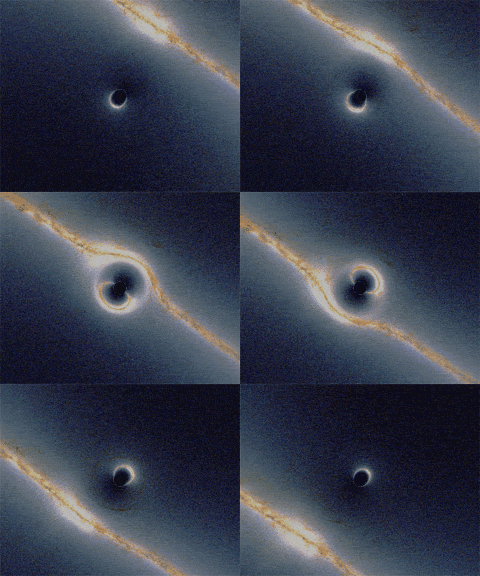
Gravitational lenses are at work in the above image! The object above is known as LRG 3-757, and APOD (Astronomy Picture of the Day, December 21, 2011) calls this a "mirage," which is indeed what it is. Watch this animation of a black hole lens, which distorts the galaxy behind it. Below is an image of the event, more like a series, which proves my point: 


You know that the galaxy behind the black hole in the images is straight, but when that black hole moves over it, we see a halo around it: that is the rings we see around galaxies, like LRG 3-757 above. These are not only beautiful in form, but intrinsic in its true scientific properties. These gravitational lenses are quite spectacular! You might think that only a few of these exist. This is not true, but rather astronomers have seen this effect in many different instances, of which each separate event being just as different as another. [Image index: 1)  Abel 1689 in Virgo. You can see the small, different mutation circlets in the background if you look hard enough. 2) Abel 370 in Cetus. These are more pronounced. 3) Abel 2280. These are thin and wispy, quite spectacular.   


Considered quite different than the above gravitational lenses, the Einstein's Cross in Pegasus (pictured below) is the most exotic of them all. Known by its appropriate name, Q2237+030 or QSO 2237+0305, is a gravitationally-lensed quasar behind ZW 2237+030, another object. Wikipedia states that "four images of the same distant quasar appear around a foreground galaxy due to strong gravitational lensing." 


Wednesday, January 25, 2012

Bach and Germany's Solar Eclipses

How is it possible that music and astronomy collide? More in reality than you think!  


Emphatically aspired as the one of the most remarkable Baroque composers that has ever lived, and arguably one of the greatest of all musical eras, Johann Sebastian Bach laid an outline of melodies, some of which we will never forget today. He was a true virtuoso, himself being an organist, harpsichordist, violist, violinist, and a composer of both sacred and secular music, which "drew together the strands of the Baroque period and brought it to its ultimate maturity," as Donald Grout states in his book, A History of Western Music [1]. In summary, Bach’s music helped reform and fundamentally redefine the Baroque era — through musical excellence and his unwavering belief in God. 

As we all know, Bach is considered as a great composer. And his music is well respected. But, how does his music relate to astronomy, and of all things, solar eclipses? Although only fragments remain, in his work, Quodlibet (called, Wedding Quodlibit) "Was seind das vor grosse Schlösser" (BWV 524), a line of the piece gives questioning. This is what the subtitle reads, in German, respectively. 
...In diesem Jahre haben wir zwei Sonnenfinsternissen...
In English translation, we can perceive it to mean "In this year we have [seen] two solar eclipses." But which events are these? Because of this indication on the piece's work, we can determine that it was written and the events happened sometime around 1705-1708 AD in central Germany (where Bach lived). From BachCantatas.com [2], "A reference to two eclipses of the sun in one year has yielded the possibility that the year in question could only be 1705, 1706, or 1708 since 1707 had only partial eclipses in the region;" this makes the question of eclipses more exact. When and what were these eclipses?

According to NASA's eclipse statistics, two eclipses within the years of 1705-1708 are recorded that are near Germany, one passing right though it: May 12, 1706, the one definite for Germany, and the other, September 14, 1708. The latter passes through the Middle east, but Germany would see partial eclipse; there are no other total/hybrid/annular events other than those. Article of the May 12, 1706 eclipse from SOA/NASA Archives.


________________________
[1] Grout, Donald (1980). A History of Western Music. W. W. Norton & Company. p. 435
[2] Bratz, Thomas. "BWV 524 Quodlibet (Fragment) 'Was seind das vor grosse Schlösser'". Retrieved 25 January 2012 from http://www.bach-cantatas.com/Articles/BWV524Quodlibet%5BBraatz%5D.htm

Sunday, December 11, 2011

December 10, 2011 Total Lunar Eclipse Results

Yesterday, sky watchers across the Pacific side of Earth witnessed a total eclipse of the Moon. During its transit through Earth's shadow, the Moon turned a bright copper color. The hue was meaningful to scientists who monitor lunar eclipses as part of their research on climate change. More on that below, but first regard this snapshot taken by James Barclay of Maidenwell, Queensland, Australia:


"The Moon looked like some alien planet hanging in a star-studded sky," says Barclay. "The excitement of those who witnessed this event will never be forgotten." (First paragraph can be found on SpaceWeather.com.

This Eclipse shall remain as one of grandiloquence and a glissade of beauty. Nothing can compare to the beauty of a total lunar eclipse! Text Reprinted below from.
Last year's winter solstice eclipse (in 2010) was a true treat to astronomers, but this year's eclipse is even more significant. If you look through NASA's eclipse catalogs, you'll find that there is, in 2012 a partial and penumbral eclipse of the moon, in 2013, a partial and two penumbrals, but in 2014 the fun begins. Meanwhile, this eclipse on December 10, 2011 is the last total lunar eclipse until 2014. But this wait should be well-worth it. In 2014 and 2015, there are four total lunar eclipse back-to-back. That, in other words, means there are four total lunar eclipses in a row, called a 'tetrad.' 
And now to the results! Let's see what astronomers captured that night.

Stephen O'Meara; Maua Loa, Hawaii "After much rain, the skies cleared just in time for us to see a stunning total lunar eclipse. This view, from the slopes of Mauna Loa volcano on Hawaii's Big Island, shows the coppery-red totally eclipsed Moon and some of the waning phases in the early morning."

MORE AT SPACEWEATHER.COM's ECLIPSE GALLERY.

Saturday, November 26, 2011

The Largest Partial Solar Eclipse of 2011: November 25 Eclipse Results

The Results are in! And yes, this eclipse was a success! Thousands of images have been pouring in on the web and I have chosen the best for Astronomical Events Calendar. The November 25, 2011 Partial-Solar Eclipse was the longest of its kind for 2011, yet 2012 brings us a rare annular eclipse among others. [The Text below was taken from the hyperlink article above].
Belonging to Saros 123, this eclipse will be seen over New Zealand, the tip of Africa, and of course Antarctica, while the greatest eclipse occurs at 06:20:17 UT with a magnitude of 0.905 near the coast of Antarctica at latitude -68° 34.1’, longitude +82° 24’. It starts at 04:23:14 UT, and ends at 08:17:16 UT.
The following picture was taken by Bonar Carson from Dunedin, New Zealand. "Partial solar eclipse from Dunedin, New Zealand. Photographed before it peaked as the clouds rolled in and blocked it from being visible at peak."


Mike Nicholson photographed the event about two minutes before sunset from Otaki Beach, NZ (above), "We were experiencing gale force Sou'westerlies when I took the picture. Low clouds plus flying salt and sand provided a natural filter to reduce the glare of the sun." The next picture was taken in Christchurch, New Zealand by "James," as he records: "I used Astro Physics 105mm Traveller and Nikon D7000 to capture some shots of the recent solar partial eclipse. There was some overcasted cloud to block the view at the first contact. Luckily, I got the better view at the final stage. But it had the optical distortion affected by the atmospheric turbulence at low horizon during the sunset."


If you know of any other pictures of this eclipse, please SUBMIT them to Spaceweather.com; as we would all like to enjoy them. [All images are not property of Astronomical Events Calendar - they have been taken from Spaceweather.com and are copyright the name above (for each picture)]. 

Monday, November 7, 2011

The Unseen Elclipses of January 4, 2011 Plus More

It was the day after the January 4, 2011 partial solar eclipses. After searching for hours over the internet for pictures of them (i.e., results) I could not come across over any pictures. But, to my dismay, just today I found those long lost pictures in browsing through NASA's APOD (known as Astronomy Picture of the Day). Below are those "lost" photographs of each eclipse, and they are spectacular! I wish I could have found them sooner. (The caption of each image is credit NASA, APOD. Credit follows.)

JANUARY 4, 2011 PARTIAL SOLAR ECLIPSE

Explanation: Seen from central and northern Asia, the Sun and New Moon set together on January 4, in a partial solar eclipse. Close to its maximum phase, the eclipse is captured near the moment of sunset in this wintry scene from the bank of the Berd River near Novosibirsk, Siberia, Russia. An evocative view in fading light, the picture looks toward the western horizon across a snowy, frozen landscape. Along with offset Sun and Moon, the dimly lit sky includes an industrial smoke plume and airplane contrail. Image COPYRIGHT Aleksandr Yuferev.

Explanation: For many Europeans, the Sun and New Moon rose together on January 4 in a partial solar eclipse. Arriving close on the heels of the new year, it was the first of a series of four(!) partial solar eclipses due in 2011. This composite image documents the graceful celestial event in colorful morning skies over Graz, Austria. Beginning before sunrise, frames were taken to record the position and progress of the eclipse every 15 minutes. As Sun and Moon rose above the eastern horizon, the town of Graz is seen bathed in warming sunlight only partially blocked by the New Moon, spreading beneath the town's landmark clock tower. Image COPRIGHT Robert Pölzl

If the eclipse wasn't enough, I cannot get over the beauty of the June 15 total lunar eclipse. Here is one of my favorite pictures, plus and accompanying video. Next Eclipse (from today, Nov 7, 2011) is NOV 25!!

Explanation: The total phase of the June 15 lunar eclipse lasted an impressive 100 minutes. Its entire duration is covered in this composite of a regular sequence of digital camera exposures, tracking the dark lunar disk as it arced above the Acropolis in Athens, Greece. In fact, around 270 BCE Greek astronomer Aristarchus also tracked the duration of lunar eclipses, though without the benefit of digital clocks and cameras. Still, using geometry, he devised a simple and impressively accurate way to calculate the Moon's distance, in terms of the radius of planet Earth, from the eclipse duration. A more modern Greek astronomer, Elias Politis titled this eclipse duration study and the accompanying youtube timelapse video "Acropoclipse". Image COPYRIGHT Elias Politis


Friday, October 14, 2011

Total Penumbral Eclipses

The last of the three types of lunar eclipses is the penumbral. The moon passes through the earth’s penumbral shadow, resulting in a slight darkening of a portion of the moon. Because this effect is not that impressive at all, it’s hard to detect and mostly are of academic interest. These eclipses are only observed for the purpose of learning (academic reason), but are a great chance for eclipse enthusiasts to witness them. Only total lunar eclipses are worth seeing to most people. But, another interesting thing occurs with penumbral eclipses. A rare subset of penumbral eclipses can be viewed rarely (approximately less than two percent of all eclipses). It is known as a total-penumbral eclipse, or just another penumbral. 

Total Penumbral eclipse of March 3, 1988

If you consider this eclipse to be a part of the others, then there are four types of lunar eclipses. The last one occurred on March 14, 2006, and you won’t see another one until August 29, 2053. The moon is totally immersed in the penumbral cone of the earth, without even touching the umbra. But occasionally, the penumbra is too small to contain the whole moon. So, the moon would have to be at its apogee (farthest point) in order to fit. When you calculate the timings of the moon being at apogee, being at full moon, and being on the ecliptic, you don’t begin to realize how rare this is.


In Total Penumbral Lunar Eclipses written by Jean Meeus, this is how he describes the frequency of total-penumbral eclipses: “the total-penumbral eclipses are unevenly distributed with time; their frequency varies in phase with that of tetrads and that of total eclipses in the umbra.” Taken from the abstract of the document, Meeus says in simpler terms that these eclipses are rare, compared to who often the moon eclipses in the umbra. Tetrads are just a set of four total umbral eclipses within two years. On another note, the color of the whole moon slightly darkens. It is neither as dark nor red like the total lunar eclipse, but you will be able to tell the color has been altered. Though only for theoretical interest, total-penumbral is nothing spectacular. “Unlike umbral eclipses, the ‘total’ type of penumbral eclipse should not be considered to be an important and beautiful phenomenon!” writes Jean Meeus on the viewing of these special eclipses.  They’re nothing special—but rare!


[This is a special interest story--images can be found here.]