Saturday, February 18, 2012

More on Gravitational Lenses: Hubble's Journey with these Exotic Sphinxes

As mentioned in Part the First of the article set concerning "Gravitational Lenses", Gravitational Lenses: the Mutant Truth of this Cosmic Conundrum, the term gravitational lens was defined by Dictionary.com as "a heavy, dense body, as a galaxy, that lies along our line of sight to a more distant object, as a quasar, and whose gravitational field refracts the light of that object, splitting it into multiple images as seen from the earth." After looking at the imaging which the Hubble Space Telescope has produced (images in previous article), it is certain that such thing called a "gravitational lens" is quite a sphinx, or an inscrutable question of something, although the concept of gravitational lenses are now far from inscrutable thanks to the Hubble!


Since it was launched in 1990, the Hubble Space Telescope has revolutionized space exploration through its exceptional cameras and imaging: such images which Hubble has seen are gravitational lenses, or "zoom lenses" as also referred to. Earlier this month, on February 2, 2012, the Astrophysics Journal published an article on the brightest magnitude gravitational lens yet photographed by Hubble, a galaxy named RCS2 032727-132623.

"Hubble's view of the distant background galaxy is significantly more detailed than could ever be achieved without the help of the gravitational lens," HubbleSite.com tells us. This object in the night sky has beautifully metamorphosed into a horseshoe-fashioned semi-circlet, and Hubble was there to record such findings. HubbleSite is definitely correct when it proclaims this objects one of the "most striking" gravitational lenses discovered!

It's reflection on modern astronomy has helped in understanding of gravitational lenses and the distant & young universe, as when we look back far into the universe, we are looking back into time.

Wednesday, February 15, 2012

Gravitational Lenses: the Mutant Truth of this Cosmic Conundrum

As defined by Dictionary.com's resources, gravitational lenses are most appropriately "a heavy, dense body, as a galaxy, that lies along our line of sight to a more distant object, as a quasar, and whose gravitational field refracts the light of that object, splitting it into multiple images as seen from the earth." Although this might seem confusing and rather arcane, this cosmic conundrum is mysterious and yet beautiful, all beginning with an Albert Einstein theorem: the theorem of relativity. Just barely scratching the surface on such a complex theory (which has been proven to be truth, see following paragraph), relativity scope deals that space and time are bent, causing things (i.e., distant objects) to be bent, or distorted. 

How was such a theorem actually confirmed to be true? Developed in 1915, it took three separate tests to confirm its reality; I will only contemplate one: the total solar eclipse. In the article published by Arthur Eddington (and other astronomers) entitled, A determination of the deflection of light by the Sun's gravitational field, from observations made at the total eclipse of 29 May 1919, Einstein's theory was claimed to be true, as Eddington writes describing the purpose, then the outcome of the endevour:
PURPOSE: "The purpose of the expeditions was to determine what effect, if any, is produced by a gravitational field on the path of a ray of light traversing it. Apart from possible surprises, there appeared to be three alternatives, which it was especially desired to discriminate between—  (1) The path is uninfluenced by gravitation. (2) The energy or mass of light is subject to gravitation in the same way as ordinary matter. If the law of gravitation is strictly the Newtonian law, this leads to an apparent displacement of a star close to the sun's limb amounting to 0” 87 outwards. (3) The course of a ray of light is in accordance with EINSTEIN’S generalized relativity theory. This leads to an apparent displacement of a star at the limb amounting to 1” 75 outwards."
RESULT: "Thus the results of the expeditions ... can leave little doubt that a deflection of light takes place in the neighborhood of the sun and that it is of the amount demanded by Einstein's generalized theory of relativity, as attributable to the sun’s gravitational field."

Now that we have determined that this is true and that time and space are actually bent, we can now look further into the mysteries of gravitational lenses. As stated before, a gravitational lens is the distortion of an object behind a closer object, which its light is seen differently than it would be seen. These are also referred to as Einstein rings. Before you try to comprehend this, look at the image below. The yellow object is a galaxy, the ring around it is as well, but not as you would expect it to have been.


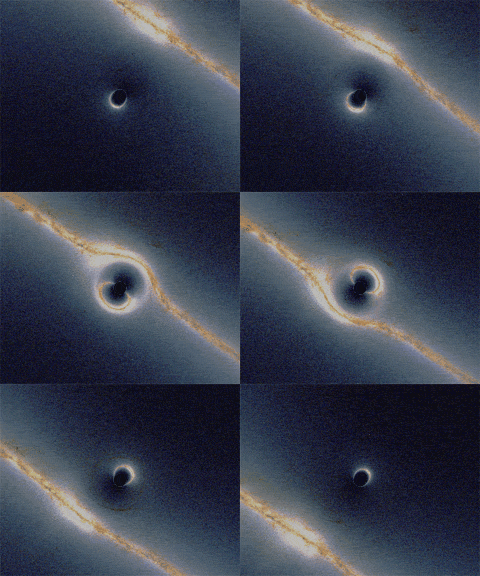
Gravitational lenses are at work in the above image! The object above is known as LRG 3-757, and APOD (Astronomy Picture of the Day, December 21, 2011) calls this a "mirage," which is indeed what it is. Watch this animation of a black hole lens, which distorts the galaxy behind it. Below is an image of the event, more like a series, which proves my point: 


You know that the galaxy behind the black hole in the images is straight, but when that black hole moves over it, we see a halo around it: that is the rings we see around galaxies, like LRG 3-757 above. These are not only beautiful in form, but intrinsic in its true scientific properties. These gravitational lenses are quite spectacular! You might think that only a few of these exist. This is not true, but rather astronomers have seen this effect in many different instances, of which each separate event being just as different as another. [Image index: 1)  Abel 1689 in Virgo. You can see the small, different mutation circlets in the background if you look hard enough. 2) Abel 370 in Cetus. These are more pronounced. 3) Abel 2280. These are thin and wispy, quite spectacular.   


Considered quite different than the above gravitational lenses, the Einstein's Cross in Pegasus (pictured below) is the most exotic of them all. Known by its appropriate name, Q2237+030 or QSO 2237+0305, is a gravitationally-lensed quasar behind ZW 2237+030, another object. Wikipedia states that "four images of the same distant quasar appear around a foreground galaxy due to strong gravitational lensing." 


Tuesday, February 7, 2012

Planetary Aperçus: Featuring Saturn and Uranus

Spoken literally from the French, aperçu is an "outline or summary" or even a "glimpse," which is what this article will give you: an impression of two planets, although rather dim when viewed by the naked eye.

SATURN GOES RETROGRADE: FEBRUARY 8, 2012

This Wednesday, February 8, 2012, Saturn will begin to go retrograde. It rises around eleven pm to midnight, in the east, and reaches the zenith around 5 am. At that time, Saturn will be seen in Virgo, west of Spica (although it will vary among locations). Its retrograde period will signify better viewing, as it will rise earlier. "Saturn will be rising earlier each evening with each passing day. It’ll soon be in a more convenient place for evening viewing," EarthSky.com reminds. Saturn will be at magnitude 0.5, so spotting it shouldn't be that hard.


What is, precisely, retrograde motion? Covered in detail when Mars went retrograde in January 2012, apparent retrograde motion is the visible, backward orbit of a planet as viewed from earth, due to the orbit of that planet. On account of the fact that earth orbits quicker than other planets (particularly the outer planets; although the inner planets (Mercury and Venus) exhibit it rather differently), earth, from time to time, will "overtake" a planet of note (such as Saturn), causing that planet to look as if it travels in reverse, periodically being motionless for a few days before and after the event. As earth then passes the planet again, we can see that it resumes its old orbit (which is normal: west to east). [There is a visual at the Mars link above]

Saturn will be at opposition April 15, 2012. Opposition is literally when Saturn is closest to earth, and brightest in the sky, but until then, Saturn's retrograde is a spectacle! Early June marks the end of Saturn's retrograde motion. Read more about Saturn from EarthSky.com. From NakedEyePlanets.

URANUS AND VENUS CONJUNCT

So vibrant will be these two planets over the next few days. Venus has been shining strong, being the second brightest object in the night sky at magnitude -4.1 (although it will be brightest when the moon goes new), and now, just 0.3 degrees beneath it will be Uranus, bluish-green! Interesting to note, Uranus shines at magnitude 5.9, almost 10000 times dimmer than Venus!, and the brighter will lead you to the dimmer. Both planets are presently in Pisces.