Showing posts with label tetrad. Show all posts

Sunday, December 11, 2011

December 10, 2011 Total Lunar Eclipse Results

Yesterday, sky watchers across the Pacific side of Earth witnessed a total eclipse of the Moon. During its transit through Earth's shadow, the Moon turned a bright copper color. The hue was meaningful to scientists who monitor lunar eclipses as part of their research on climate change. More on that below, but first regard this snapshot taken by James Barclay of Maidenwell, Queensland, Australia:
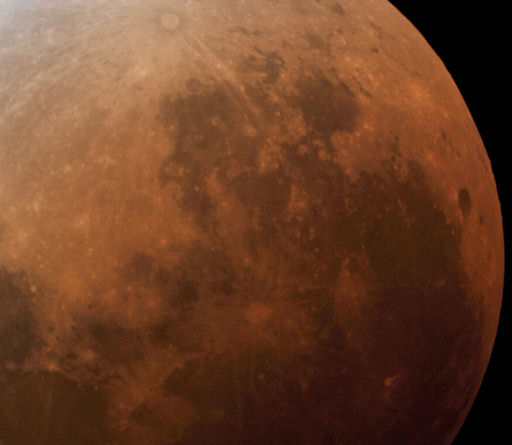


"The Moon looked like some alien planet hanging in a star-studded sky," says Barclay. "The excitement of those who witnessed this event will never be forgotten." (First paragraph can be found on SpaceWeather.com.

This Eclipse shall remain as one of grandiloquence and a glissade of beauty. Nothing can compare to the beauty of a total lunar eclipse! Text Reprinted below from.
Last year's winter solstice eclipse (in 2010) was a true treat to astronomers, but this year's eclipse is even more significant. If you look through NASA's eclipse catalogs, you'll find that there is, in 2012 a partial and penumbral eclipse of the moon, in 2013, a partial and two penumbrals, but in 2014 the fun begins. Meanwhile, this eclipse on December 10, 2011 is the last total lunar eclipse until 2014. But this wait should be well-worth it. In 2014 and 2015, there are four total lunar eclipse back-to-back. That, in other words, means there are four total lunar eclipses in a row, called a 'tetrad.' 
And now to the results! Let's see what astronomers captured that night.

Stephen O'Meara; Maua Loa, Hawaii "After much rain, the skies cleared just in time for us to see a stunning total lunar eclipse. This view, from the slopes of Mauna Loa volcano on Hawaii's Big Island, shows the coppery-red totally eclipsed Moon and some of the waning phases in the early morning."

MORE AT SPACEWEATHER.COM's ECLIPSE GALLERY.

Friday, October 14, 2011

Total Penumbral Eclipses

The last of the three types of lunar eclipses is the penumbral. The moon passes through the earth’s penumbral shadow, resulting in a slight darkening of a portion of the moon. Because this effect is not that impressive at all, it’s hard to detect and mostly are of academic interest. These eclipses are only observed for the purpose of learning (academic reason), but are a great chance for eclipse enthusiasts to witness them. Only total lunar eclipses are worth seeing to most people. But, another interesting thing occurs with penumbral eclipses. A rare subset of penumbral eclipses can be viewed rarely (approximately less than two percent of all eclipses). It is known as a total-penumbral eclipse, or just another penumbral. 

Total Penumbral eclipse of March 3, 1988

If you consider this eclipse to be a part of the others, then there are four types of lunar eclipses. The last one occurred on March 14, 2006, and you won’t see another one until August 29, 2053. The moon is totally immersed in the penumbral cone of the earth, without even touching the umbra. But occasionally, the penumbra is too small to contain the whole moon. So, the moon would have to be at its apogee (farthest point) in order to fit. When you calculate the timings of the moon being at apogee, being at full moon, and being on the ecliptic, you don’t begin to realize how rare this is.


In Total Penumbral Lunar Eclipses written by Jean Meeus, this is how he describes the frequency of total-penumbral eclipses: “the total-penumbral eclipses are unevenly distributed with time; their frequency varies in phase with that of tetrads and that of total eclipses in the umbra.” Taken from the abstract of the document, Meeus says in simpler terms that these eclipses are rare, compared to who often the moon eclipses in the umbra. Tetrads are just a set of four total umbral eclipses within two years. On another note, the color of the whole moon slightly darkens. It is neither as dark nor red like the total lunar eclipse, but you will be able to tell the color has been altered. Though only for theoretical interest, total-penumbral is nothing spectacular. “Unlike umbral eclipses, the ‘total’ type of penumbral eclipse should not be considered to be an important and beautiful phenomenon!” writes Jean Meeus on the viewing of these special eclipses.  They’re nothing special—but rare!


[This is a special interest story--images can be found here.]