Showing posts with label total lunar eclipse. Show all posts

Sunday, December 11, 2011

December 10, 2011 Total Lunar Eclipse Results

Yesterday, sky watchers across the Pacific side of Earth witnessed a total eclipse of the Moon. During its transit through Earth's shadow, the Moon turned a bright copper color. The hue was meaningful to scientists who monitor lunar eclipses as part of their research on climate change. More on that below, but first regard this snapshot taken by James Barclay of Maidenwell, Queensland, Australia:
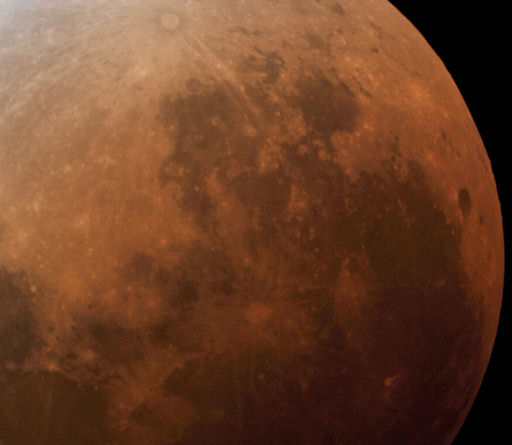


"The Moon looked like some alien planet hanging in a star-studded sky," says Barclay. "The excitement of those who witnessed this event will never be forgotten." (First paragraph can be found on SpaceWeather.com.

This Eclipse shall remain as one of grandiloquence and a glissade of beauty. Nothing can compare to the beauty of a total lunar eclipse! Text Reprinted below from.
Last year's winter solstice eclipse (in 2010) was a true treat to astronomers, but this year's eclipse is even more significant. If you look through NASA's eclipse catalogs, you'll find that there is, in 2012 a partial and penumbral eclipse of the moon, in 2013, a partial and two penumbrals, but in 2014 the fun begins. Meanwhile, this eclipse on December 10, 2011 is the last total lunar eclipse until 2014. But this wait should be well-worth it. In 2014 and 2015, there are four total lunar eclipse back-to-back. That, in other words, means there are four total lunar eclipses in a row, called a 'tetrad.' 
And now to the results! Let's see what astronomers captured that night.

Stephen O'Meara; Maua Loa, Hawaii "After much rain, the skies cleared just in time for us to see a stunning total lunar eclipse. This view, from the slopes of Mauna Loa volcano on Hawaii's Big Island, shows the coppery-red totally eclipsed Moon and some of the waning phases in the early morning."

MORE AT SPACEWEATHER.COM's ECLIPSE GALLERY.

Wednesday, December 7, 2011

The Last Total Lunar Eclipse Until 2014: December 10, 2011, The Moon Eclipses!

Last year's winter solstice eclipse (in 2010) was a true treat to astronomers, but this year's eclipse is even more significant. If you look through NASA's eclipse catalogs, you'll find that there is, in 2012 a partial and penumbral eclipse of the moon, in 2013, a partial and two penumbrals, but in 2014 the fun begins. Meanwhile, this eclipse on December 10, 2011 is the last total lunar eclipse until 2014. But this wait should be well-worth it. In 2014 and 2015, there are four total lunar eclipse back-to-back. That, in other words, means there are four total lunar eclipses in a row, called a 'tetrad.'


The above visibility map shows everything about how and when to view the eclipse. General information about this astronomical event is included below, courtesy of Wikipedia. This year, this event will take place in the constellation of Taurus, the bull. It is also part of Saros cycle 135.
Duration (hr:mn:sc)
Totality 00:51:08
Partial 3:32:15
Penumbral 5:56:21
Contacts
P1 11:33:36 UTC
U1 12:45:43 UTC
U2 14:06:16 UTC
Greatest 14:31:49 UTC
U3 14:57:24 UTC
U4 16:17:58 UTC
P4 17:29:57 UTC


Thanks to Night Sky Info: The eclipse's partial phases begin at 4:46 A.M. PST (12:46 UT), when the Moon's leading edge enters the dark umbra of Earth's shadow, and the celestial show ends at 8:18 A.M. PST (16:18 UT), when the Moon's disk completely exits the umbra. Totality starts at 6:06 A.M. PST (14:06 UT) and ends at 6:57 A.M. PST (14:57 UT). This year's last eclipse is a total lunar eclipse on December 10, best visible from Asia and Australia. For people on the west coast of the United States and Canada the eclipse is in progress as the Moon sets, and observers throughout Europe and Africa will miss the early eclipse phases because they occur before moonrise.


Tetrad Dates and Times provided by NASA:

2014 Apr 15 07:46:48 Total 122 1.291 03h35m
01h18m
Aus., Pacific, Americas
2014 Oct 08 10:55:44 Total 127 1.166 03h20m
00h59m
Asia, Aus., Pacific, Americas
2015 Apr 04 12:01:24 Total 132 1.001 03h29m
00h05m
Asia, Aus., Pacific, Americas
2015 Sep 28 02:48:17 Total 137 1.276 03h20m
01h12m
e Pacific, Americas, Europe, Africa, w       

Monday, November 7, 2011

The Unseen Elclipses of January 4, 2011 Plus More

It was the day after the January 4, 2011 partial solar eclipses. After searching for hours over the internet for pictures of them (i.e., results) I could not come across over any pictures. But, to my dismay, just today I found those long lost pictures in browsing through NASA's APOD (known as Astronomy Picture of the Day). Below are those "lost" photographs of each eclipse, and they are spectacular! I wish I could have found them sooner. (The caption of each image is credit NASA, APOD. Credit follows.)

JANUARY 4, 2011 PARTIAL SOLAR ECLIPSE

Explanation: Seen from central and northern Asia, the Sun and New Moon set together on January 4, in a partial solar eclipse. Close to its maximum phase, the eclipse is captured near the moment of sunset in this wintry scene from the bank of the Berd River near Novosibirsk, Siberia, Russia. An evocative view in fading light, the picture looks toward the western horizon across a snowy, frozen landscape. Along with offset Sun and Moon, the dimly lit sky includes an industrial smoke plume and airplane contrail. Image COPYRIGHT Aleksandr Yuferev.

Explanation: For many Europeans, the Sun and New Moon rose together on January 4 in a partial solar eclipse. Arriving close on the heels of the new year, it was the first of a series of four(!) partial solar eclipses due in 2011. This composite image documents the graceful celestial event in colorful morning skies over Graz, Austria. Beginning before sunrise, frames were taken to record the position and progress of the eclipse every 15 minutes. As Sun and Moon rose above the eastern horizon, the town of Graz is seen bathed in warming sunlight only partially blocked by the New Moon, spreading beneath the town's landmark clock tower. Image COPRIGHT Robert Pölzl

If the eclipse wasn't enough, I cannot get over the beauty of the June 15 total lunar eclipse. Here is one of my favorite pictures, plus and accompanying video. Next Eclipse (from today, Nov 7, 2011) is NOV 25!!

Explanation: The total phase of the June 15 lunar eclipse lasted an impressive 100 minutes. Its entire duration is covered in this composite of a regular sequence of digital camera exposures, tracking the dark lunar disk as it arced above the Acropolis in Athens, Greece. In fact, around 270 BCE Greek astronomer Aristarchus also tracked the duration of lunar eclipses, though without the benefit of digital clocks and cameras. Still, using geometry, he devised a simple and impressively accurate way to calculate the Moon's distance, in terms of the radius of planet Earth, from the eclipse duration. A more modern Greek astronomer, Elias Politis titled this eclipse duration study and the accompanying youtube timelapse video "Acropoclipse". Image COPYRIGHT Elias Politis


Friday, October 14, 2011

Total Penumbral Eclipses

The last of the three types of lunar eclipses is the penumbral. The moon passes through the earth’s penumbral shadow, resulting in a slight darkening of a portion of the moon. Because this effect is not that impressive at all, it’s hard to detect and mostly are of academic interest. These eclipses are only observed for the purpose of learning (academic reason), but are a great chance for eclipse enthusiasts to witness them. Only total lunar eclipses are worth seeing to most people. But, another interesting thing occurs with penumbral eclipses. A rare subset of penumbral eclipses can be viewed rarely (approximately less than two percent of all eclipses). It is known as a total-penumbral eclipse, or just another penumbral. 

Total Penumbral eclipse of March 3, 1988

If you consider this eclipse to be a part of the others, then there are four types of lunar eclipses. The last one occurred on March 14, 2006, and you won’t see another one until August 29, 2053. The moon is totally immersed in the penumbral cone of the earth, without even touching the umbra. But occasionally, the penumbra is too small to contain the whole moon. So, the moon would have to be at its apogee (farthest point) in order to fit. When you calculate the timings of the moon being at apogee, being at full moon, and being on the ecliptic, you don’t begin to realize how rare this is.


In Total Penumbral Lunar Eclipses written by Jean Meeus, this is how he describes the frequency of total-penumbral eclipses: “the total-penumbral eclipses are unevenly distributed with time; their frequency varies in phase with that of tetrads and that of total eclipses in the umbra.” Taken from the abstract of the document, Meeus says in simpler terms that these eclipses are rare, compared to who often the moon eclipses in the umbra. Tetrads are just a set of four total umbral eclipses within two years. On another note, the color of the whole moon slightly darkens. It is neither as dark nor red like the total lunar eclipse, but you will be able to tell the color has been altered. Though only for theoretical interest, total-penumbral is nothing spectacular. “Unlike umbral eclipses, the ‘total’ type of penumbral eclipse should not be considered to be an important and beautiful phenomenon!” writes Jean Meeus on the viewing of these special eclipses.  They’re nothing special—but rare!


[This is a special interest story--images can be found here.]